
Iron deficiency rarely means a field is short on iron. Most soils have plenty of it. The real problem is availability, and it's why choosing the right iron fertilizer matters more than the percentage printed on the jug. When soil chemistry locks iron out of reach, the plant can't use what's already there, and correction has to happen through the leaf.
Why Iron Deficiency Happens Even When Soil Tests Look Fine
Several common field conditions push iron out of a soluble, plant-available form:
High soil pH. Iron availability drops sharply as pH climbs, which is why chlorosis is so common on calcareous or over-limed ground.
Compacted or poorly aerated soils. Restricted oxygen at the root zone interferes with iron uptake.
High phosphorus levels or recent phosphorus applications. Phosphate reacts with iron to form insoluble compounds, tying it up before the plant can use it.
Elevated manganese, zinc, or copper. These micronutrients compete with iron for uptake and can induce deficiency even when soil iron levels look adequate.
The phosphorus-iron relationship is well documented on Mulder's Chart, which maps antagonistic and synergistic nutrient interactions in the plant. Iron and phosphorus sit in one of the more consequential antagonistic pairs on the chart. Heavy phosphorus programs, especially on high-pH ground where phosphate availability is already a focus, can quietly induce iron deficiency as a side effect of an otherwise sound fertility plan.
Because these conditions are widespread, an effective iron fertilizer program is a recurring need rather than an occasional fix.
What Iron Actually Does Inside the Plant
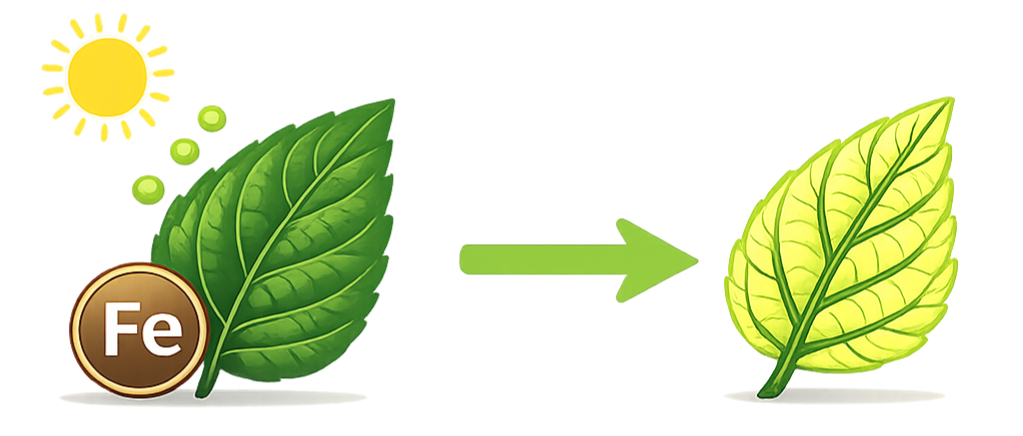
Chlorophyll synthesis. Iron is required for chlorophyll development. Without it, plants can't build the pigment that captures light energy for photosynthesis, which is why deficiency shows up as inter-veinal chlorosis on new growth.
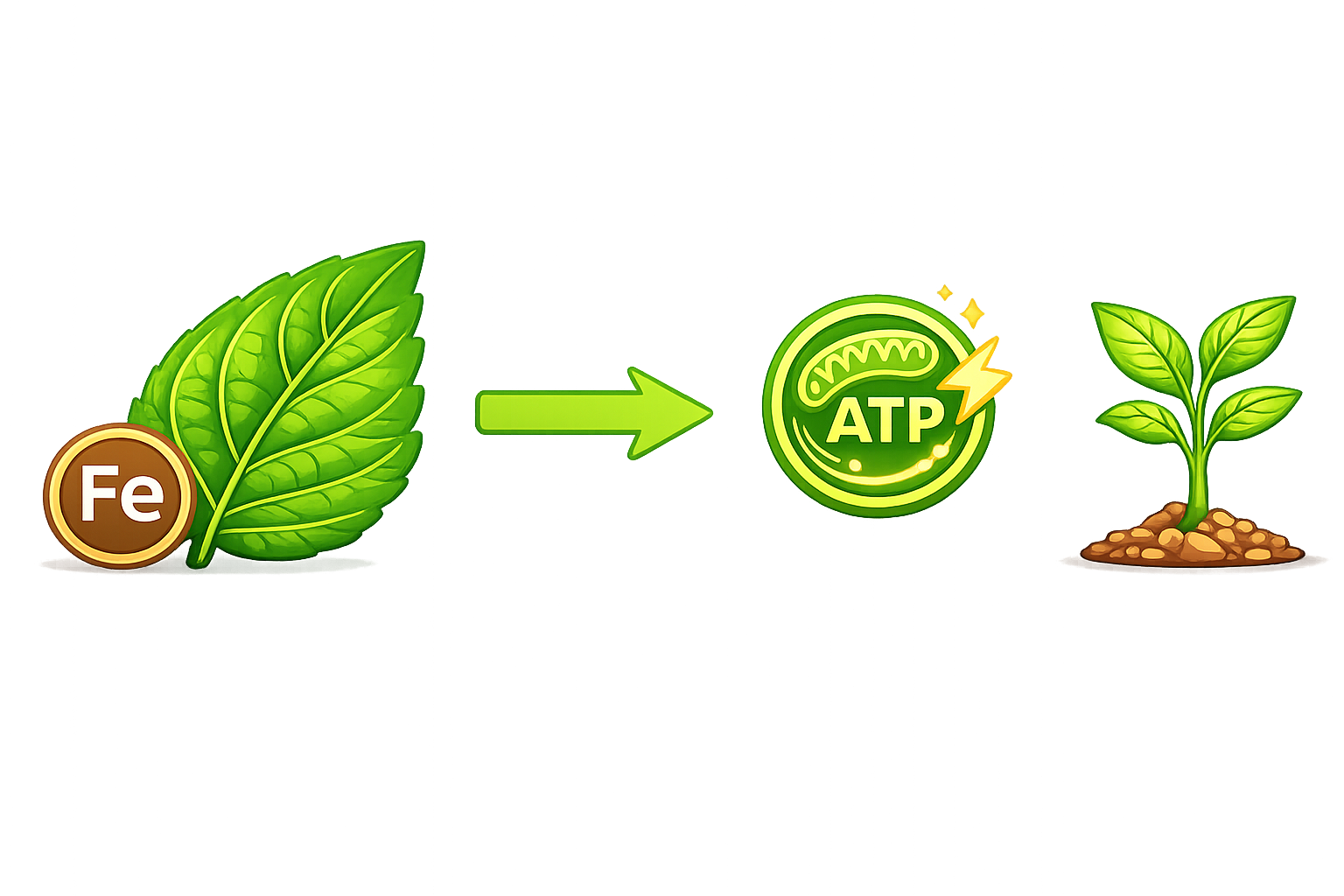
Respiration and energy production. Iron is a cofactor in the enzymes that drive plant respiration and metabolism, including ATP synthesis, the energy currency every plant cell runs on.
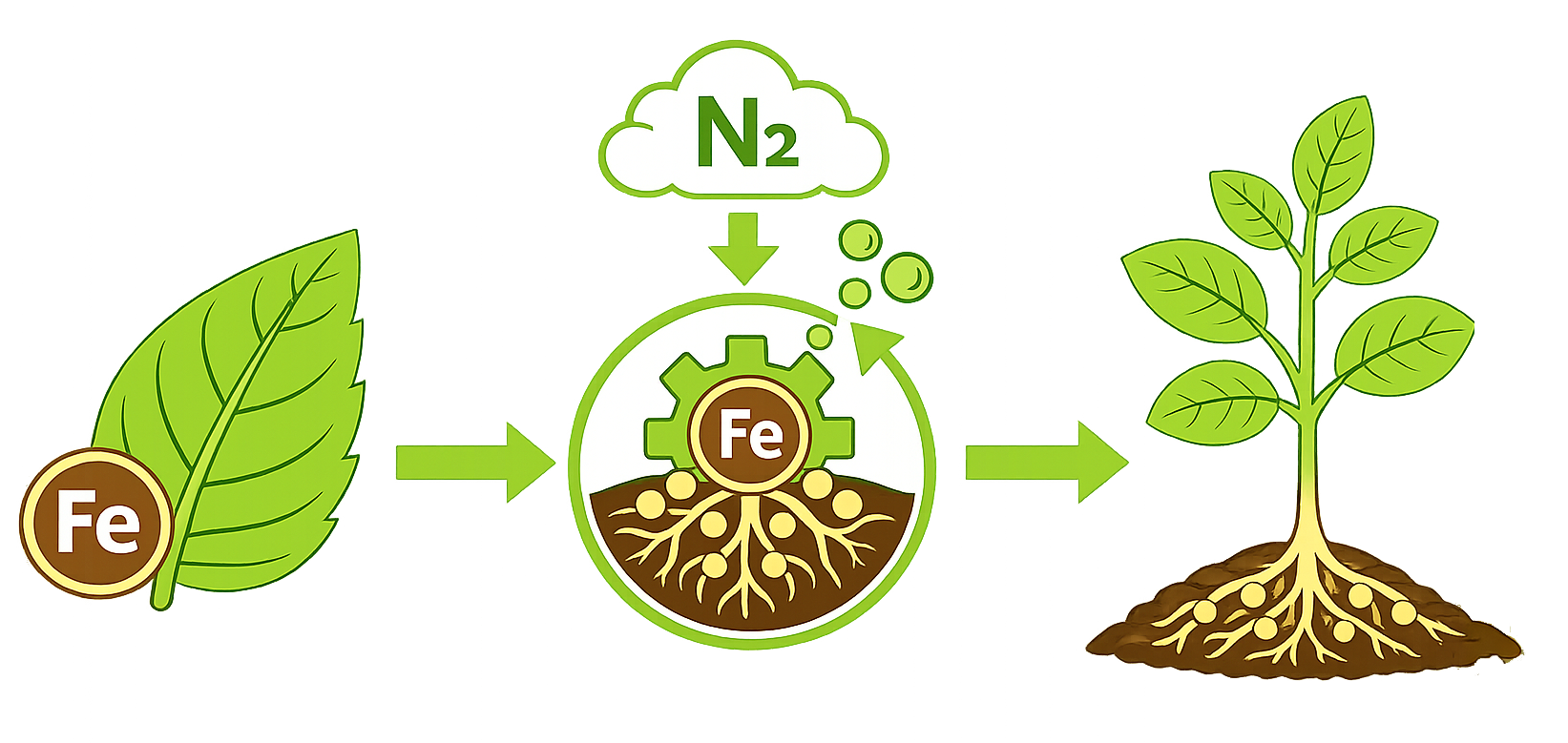
Nitrogen fixation. In legumes, iron supports the nitrogenase enzyme system that rhizobia use to fix atmospheric nitrogen. Iron-deficient legumes can under-fix nitrogen even when nodulation looks adequate.
Not All Iron Fertilizer Sources Perform the Same Way
Getting iron onto the leaf is only half the job. It still has to cross the cuticle and reach living cells. This is where the chemistry behind an iron fertilizer matters more than the number on the guaranteed analysis.
Traditional chelates like EDDHA and EDTA hold the metal ion with strong, multi-point bonds. That stability is useful in soil, but it works against the nutrient once it's on a leaf: the tighter and larger the chelate structure, the harder it is for iron to dissociate from its carrier and pass through the leaf's protective cuticle. EDTA, for comparison, has a molecular weight of roughly 435 g/mol, well over double that of iron acetate fertilizer at 173.93 g/mol.
Acetate-bound iron works differently. The bond between the acetate carrier and the iron ion is comparatively weak, so iron releases from the carrier more readily on contact with the leaf. Fewer total bonds also keep the molecule smaller, and a smaller molecule moves more easily through the cuticle, stomata, and other epidermal structures to reach internal cells. Uptake through these pathways is generally achieved within hours of application, so the same weaker bond that speeds absorption also means the iron is taken up well before it has a chance to oxidize or tie up on the leaf surface.
The Trial Data: Acetate-Bound Iron vs. Iron EDDHA
2025 North Dakota State University soybean trial. FeAce (5% Iron Acetate) was applied at 2 quarts per acre against an equally concentrated 5% Iron EDDHA product, with tissue sampled at 3 and 7 days post-application:
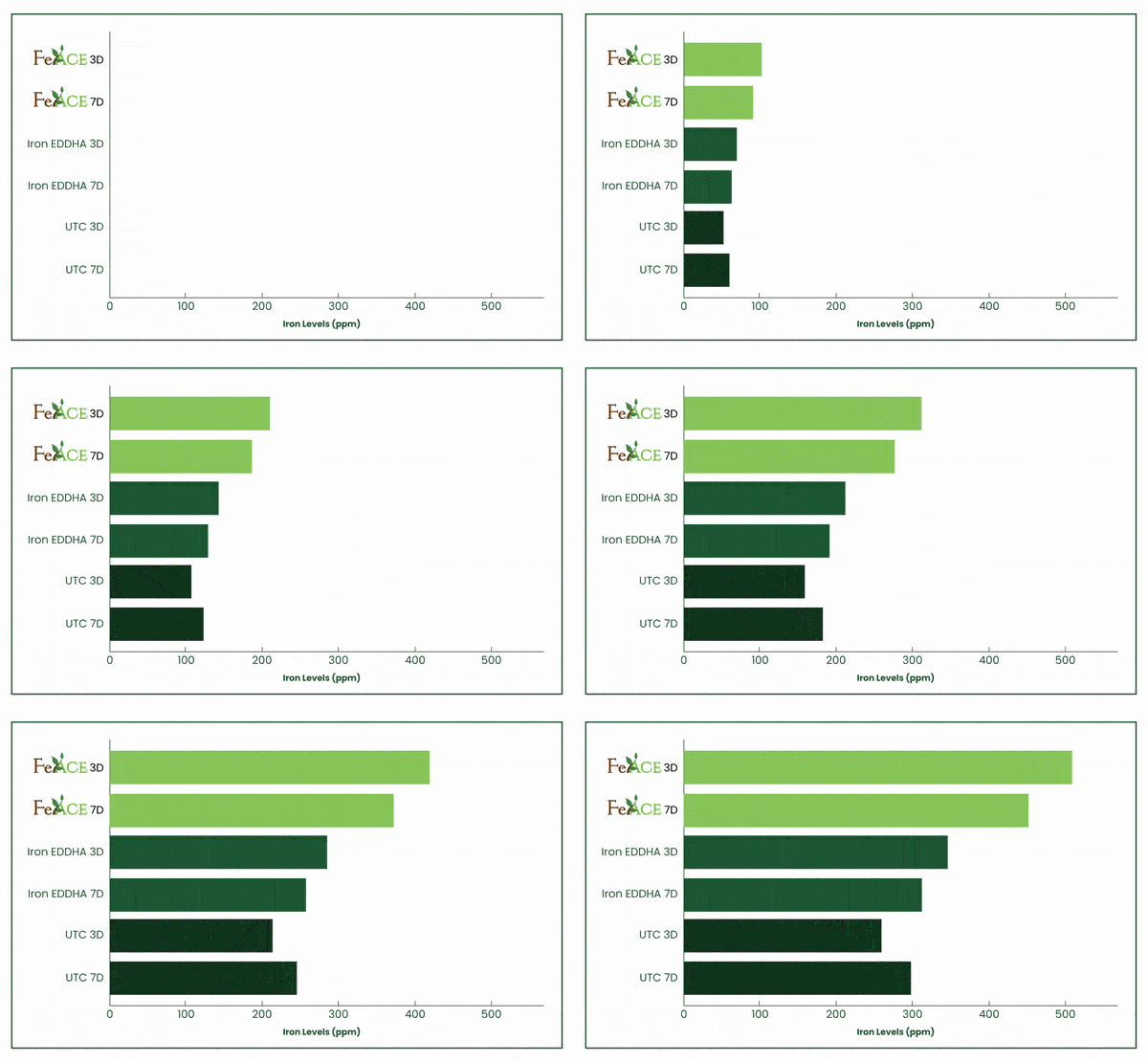
3 days after application: FeAce showed a 91% increase in tissue iron over the untreated check and a 49% advantage over Iron EDDHA.
7 days after application: FeAce maintained a 52% advantage over the untreated check and a 45% advantage over Iron EDDHA.
The advantage held from day 3 through day 7 rather than fading, indicating the iron that entered the plant stayed metabolically available rather than spiking and dropping off.
2024 FeAce Foliar Application 3rd Party Trial
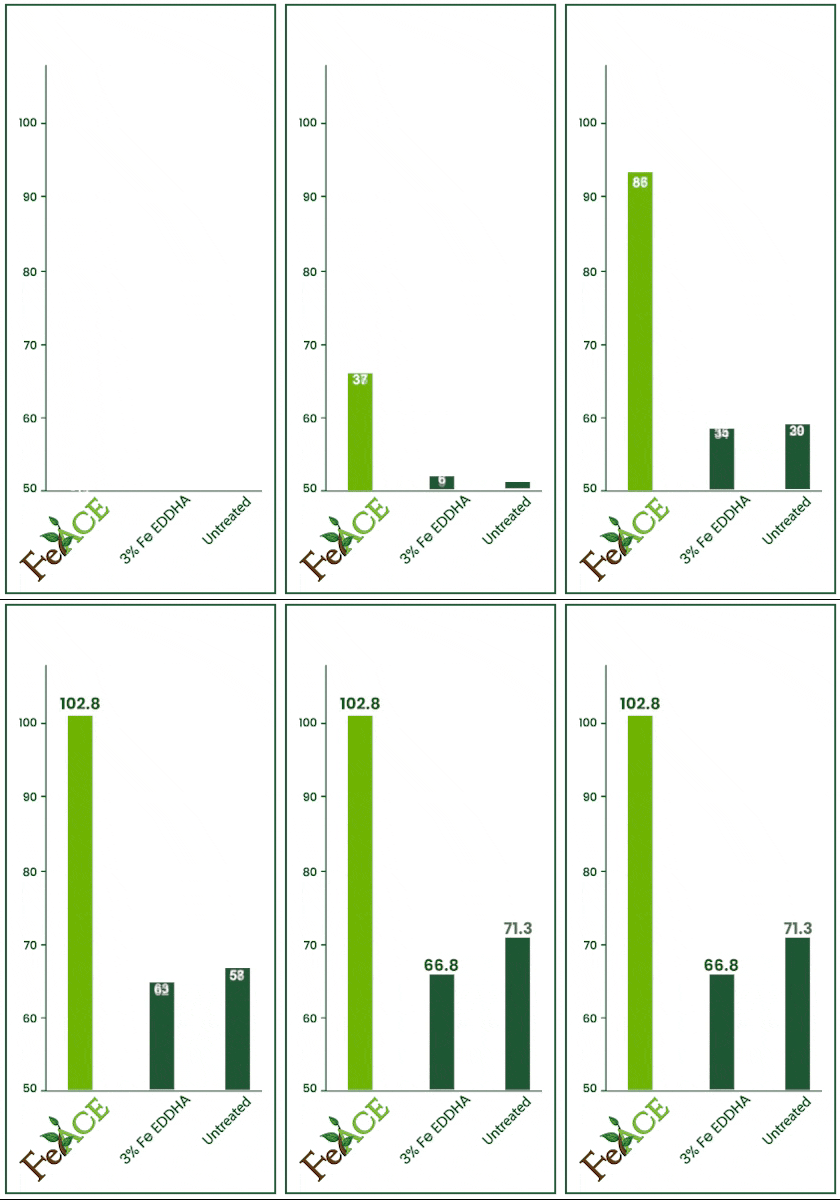
In a separate independent trial, FeAce applied at 2 quarts per acre increased tissue iron by 53.89% over an Iron EDDHA comparison and 44.18% over an untreated check, corroborating the NDSU pattern under different field conditions.
Separately, University of Arkansas research on EDTA's effect on foliar absorption found that EDTA's high molecular weight and negative charge measurably hinder nutrient uptake through the leaf cuticle, a mechanism consistent with what these iron trials show in practice.
Choosing an Iron Fertilizer for a Fertility Program
An acetate-based iron fertilizer fits a broad range of application timings, which makes it easy to layer into an existing spray program rather than requiring a dedicated pass: early vegetative stages for row and field crops, early bud and post-cutting for legumes when nitrogen-fixation demand is highest, and regular intervals through the season for crops on high-pH ground prone to chronic chlorosis.

Although it's derived from ferrous acetate rather than a chelate, FeAce is also compatible with most standard pesticide tank mixes, though a jar test is still recommended before any new combination. A closer breakdown of the cost and performance case against EDTA is available here.
The Takeaway
Iron deficiency is rarely a supply problem. It's an availability problem, compounded by high pH, phosphorus antagonism, compacted soils, and competing micronutrients. Trial data from NDSU, corroborated by a separate third-party trial, points to acetate-bound iron reaching plant tissue faster and in greater concentration than EDDHA-chelated iron under comparable conditions. That's a delivery-chemistry advantage worth weighing regardless of which iron fertilizer ends up in the tank.