
When phosphate costs more to make, every gallon matters. PFM™ helps the phosphate you apply work harder, so you can use less of it.
It takes about four-tenths of a ton of sulfur to make one ton of phosphate fertilizer. When sulfur goes from under $100 a ton to over $1,000, that math eventually shows up on the invoice. Add rising ammonia costs and tight supply in some areas, and phosphate becomes one of the hardest line items to manage heading into 2027. The harder truth is that in a typical season, most of the phosphate a grower applies never reaches the crop.
That’s the problem CultivAce PFM™ (Phosphorus Fertilizer Management) was developed to address. PFM is an additive blended into liquid phosphate, such as 10-34-0 or CultivAce’s Free Phos 24, to help more of that phosphate stay available to the plant. Below, CultivAce CEO Wayne Sledge shares his view of the 2027 market, followed by results from PFM trials in corn, sugar beets and potatoes.

Potatoes, Walsh County, ND. Left: grower standard. Right: 3 gallons of 8-24-0 + PFM™.
Why Are Phosphate Fertilizer Prices Rising for 2027?
Phosphate fertilizer prices are rising because two of its three raw materials, sulfur and ammonia, have surged on the world market. Making one ton of phosphate fertilizer takes roughly 1.5 to 2 tons of phosphate rock, 0.4 ton of sulfur and 0.2 ton of ammonia. Sulfur is recovered from oil and gas processing, and ammonia is made from natural gas, so shipping disruptions in the Middle East hit both at once.
Sulfur moved the most. Fertilizer Daily reported sulfur topping $1,000 per metric ton in global spot markets, up from under $100 in 2024. Producers felt it fast: OCP, a major phosphate producer, saw sulfur costs roughly triple while phosphate prices rose only about 20%, and North American producers have reported negative margins and cut output under the same pressure.
"When you see the price of sulfur go from around $50 a ton to over $1,000 a ton, and it takes four-tenths of a ton to make a ton of phosphate fertilizer, you can see that's going to dramatically increase the price of phosphate fertilizer." Wayne Sledge, CultivAce
Agricultural economists at the University of Illinois and Ohio State, in an analysis published on Farms.com, expect higher fertility costs for the 2027 crop year. Even if raw materials ease, inventories, contracts and freight mean relief takes months to reach the dealer.
What Is Phosphate Fertilizer Efficiency?
Phosphate fertilizer efficiency is the share of applied phosphate the crop actually takes up. With conventional programs, first-year phosphorus use efficiency typically runs just 10% to 30%. The rest stays in the soil, out of reach of this year's crop.
Three things drive that loss:
Soil tie-up. Phosphate binds to calcium in alkaline soils and to iron and aluminum in acidic soils, locking it up before roots can reach it.
The wrong form at the wrong time. Plants only absorb orthophosphate. Common starters like 10-34-0 are mostly polyphosphate, which has to convert to orthophosphate first, and that conversion slows in cold spring soils.
Placement. Phosphate barely moves in soil, so most of it reaches the root by diffusion. If it ties up before the root arrives, it is lost to the crop.
When phosphate was cheap, growers could cover that loss with volume. At 2027 prices, paying for phosphate the crop never uses is the most expensive line on the fertility budget.
How Does PFM™ Improve Phosphate Fertilizer Efficiency?
PFM™ is an additive. It is blended into a liquid phosphate fertilizer, such as conventional 10-34-0 or CultivAce's own Free Phos 24 (an in-house 8-24-0), and is designed to help more of that phosphate stay available to the plant.
Works with the phosphate you already use. PFM can be added to 10-34-0 and is the base of Free Phos 24, so it fits into existing starter and pop-up programs.
Designed to reduce tie-up. PFM is formulated to help keep phosphate soluble, so less of it locks up with calcium, iron or aluminum before roots can reach it.
Pairs with an orthophosphate source. Free Phos 24 is 100% orthophosphate with a low salt index, so its phosphate is plant-available without a conversion step and suited to in-furrow and pop-up placement.
The goal is simple: get more from every gallon of phosphate you buy. Learn more on the PFM™ page.
Wayne Sledge on PFM™ and the 2027 Season

CultivAce CEO Wayne Sledge has spent more than five decades in agriculture. His view of 2027 is direct: the phosphate squeeze will hit bottom lines before it hits yields, and efficiency is the way through it.
"Our answer to this problem is a product we make called PFM™. The dealer has the ability to combine it with liquid phosphate, use less per acre, and maintain at least the same yield, if not higher. Typically in our trials we've had higher yields where we've used that product."
On how much more efficient PFM™ makes a starter program:
"If you're comparing 10-34-0 by itself to 10-34-0 enhanced with PFM™, we can easily replace about 70% of that phosphate. We've done even more than that in the past. In a pop-up situation, you could go as low as a gallon to a gallon and a half per acre, and it's a whole lot more efficient than 10-34-0 alone."
And on the market ahead:
"It's going to be a very interesting year. What we all hope for is higher commodity prices to make it all work. At minimum, there are going to be shortages in some areas, which leads to higher prices. That's what growers should be aware of for the 2027 season."
PFM™ Trial Results
Below are results from trials that used PFM-enhanced phosphate. Each compares PFM against the grower's standard program or another starter in the same field.
Corn, Northwood, Iowa (2025, two field sites): 3 gal/ac 8-24-0 + PFM™ vs. 8 gal/ac 10-34-0. Site 1: 214 vs. 203 bu/ac. Site 2: 218 vs. 198 bu/ac.
Corn, Barnesville, Minnesota (2025): 3 gal/ac 8-24-0 + PFM™ vs. 5 gal/ac 7-17-3. 190 vs. 176 bu/ac.
Corn, Montpelier, Indiana (2023): 3 gal/ac 8-24-0 + PFM™ vs. 4.5 gal/ac 6-24-6 plus 2 qt/ac of a biological. 238 vs. 225 bu/ac.
Sugar beets, near Nordick, Minnesota (2025, independent third-party trial): 3 gal/ac 8-24-0 + PFM™ compared with three other in-furrow starter programs, including 3 gal/ac 10-34-0. PFM: 31.24 tons/ac and 7,794 lb recoverable sugar/ac. 10-34-0: 30.03 tons/ac and 7,644 lb.
Potatoes, Inkster, North Dakota (2025, North Dakota State University Department of Plant Sciences): 8-24-0 + PFM™ in-furrow vs. the grower standard. Dakota Gold: 249 vs. 222 cwt/ac. Dakota Skarlagen: 214 vs. 201 cwt/ac. Red Norland: 192 vs. 172 cwt/ac.
Potatoes, Idaho (2019, third-party trial): 3 gal/ac Free Phos 8-24-0 + PFM™ vs. 5 gal/ac of two other starters (6-20-0 + 0.77 Zn and 7-21-1 + 0.2 Zn). Total yield: 471 cwt/ac vs. 412 and 414 cwt/ac.
Potatoes, Clearwater, Washington (2019, third-party tissue study): Free Phos 24 + PFM™ at 5 gal/ac total vs. 10-34-0 at 10 gal/ac total. Early-season tissue samples measured 83% more phosphorus and higher nitrate-nitrogen (36,000 vs. 24,000 ppm) in the PFM plots.
These are individual field trials, and results vary with soil, weather and management. Yield figures do not account for product or application cost. Talk with your CultivAce representative about what PFM could look like in your program.
See more PFM™ field results and grower photos.
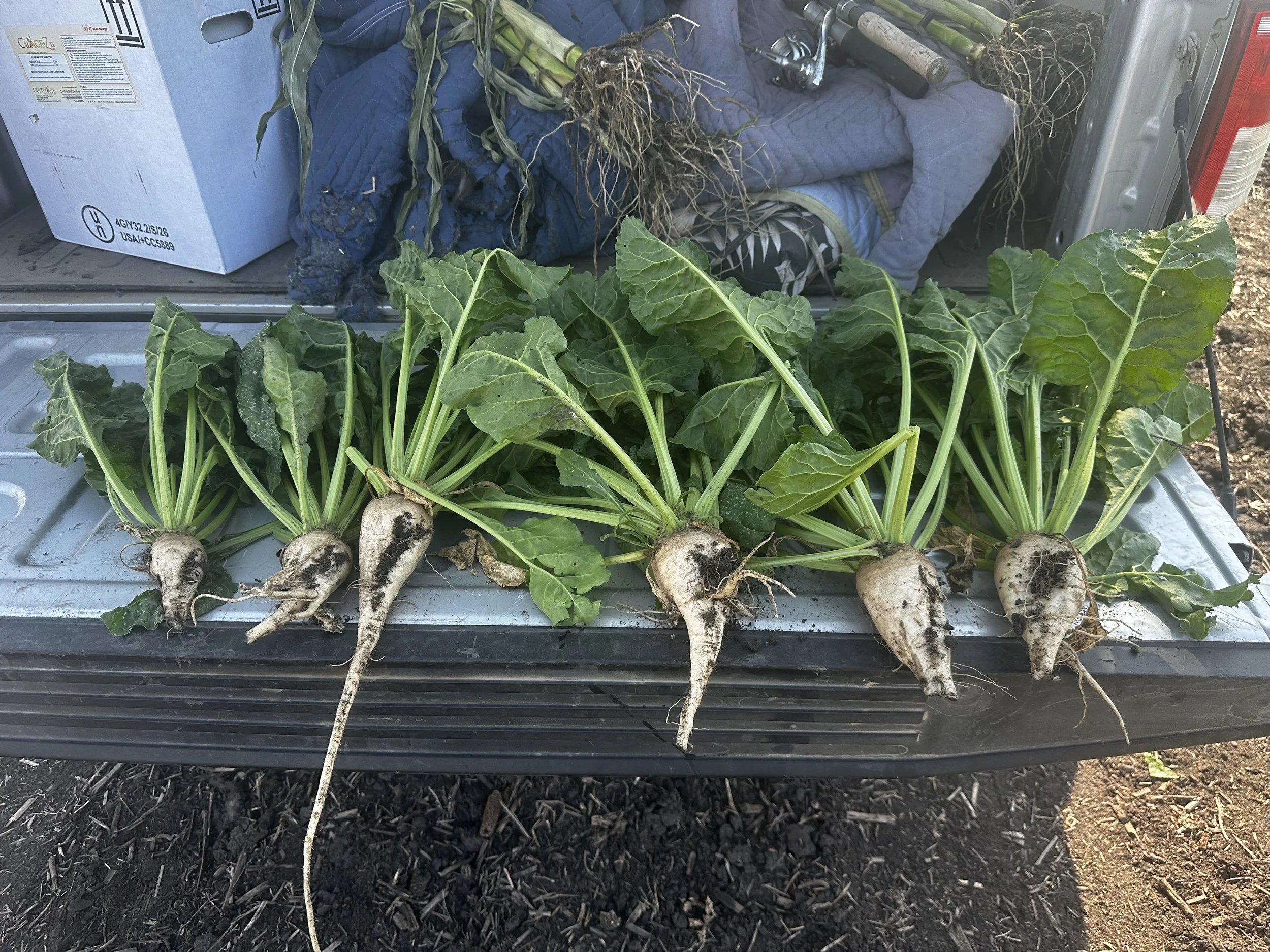
Sugar beets, Clay County, MN (on-farm comparison). Left: grower standard. Right: 3 gallons of 8-24-0 + PFM™.
What This Means for Your 2027 Phosphate Budget
High phosphate prices raise the cost of every gallon you buy. That makes efficiency the first place to look: the more of each gallon the crop can use, the more room there is to manage cost per acre.
Wayne's advice for growers is to plan now, before spot shortages tighten supply:
Talk with your dealer about your 2027 starter and phosphate program.
Have your dealer contact CultivAce about PFM™.
Build a program focused on getting more from every gallon of phosphate.
Ready to plan your 2027 program? Contact your CultivAce representative or learn more about PFM™.
Frequently Asked Questions
Will phosphate fertilizer prices stay high in 2027?
Most signs point to yes. Sulfur and ammonia costs remain elevated, producers have cut output, and price relief takes months to reach dealers, so Spring 2027 phosphate is likely to stay expensive and tight in some areas.
How can I improve phosphate fertilizer efficiency?
Use an orthophosphate source, place it close to the seed, and limit soil tie-up. PFM is an additive designed to help reduce tie-up, and it can be paired with an orthophosphate product like Free Phos 24.
How much phosphate can PFM replace?
Compared with 10-34-0 alone, Wayne Sledge says PFM-enhanced phosphate can replace about 70% of the phosphate. In a 2025 Iowa trial, 3 gallons of 8-24-0 + PFM yielded 214 and 218 bu/ac at two sites, compared with 203 and 198 bu/ac for 8 gallons of 10-34-0.
What is the PFM™ pop-up rate?
According to Wayne Sledge, PFM-enhanced phosphate can go as low as 1 to 1.5 gallons per acre in a pop-up program. Talk with your CultivAce representative about the right rate for your operation.
Can PFM™ be used with 10-34-0?
Yes. PFM™ does not replace your phosphorus. It is an additive that can be blended into 10-34-0 or into Free Phos 24, CultivAce's in-house 8-24-0, to help with phosphorus efficiency. Talk with your dealer or CultivAce representative about rates for your program.
Sources
Sulfur and Increasing Phosphate Fertilizer Prices, Farms.com
Sulfur Tops $1,000/t, Reshaping Phosphate Fertilizer Economics, Fertilizer Daily
OCP H1 2026: Sulfur Costs Triple, Fertilizer Daily
Phosphate Producers Face Negative Margins, Fertilizer Daily
Sulfur Shortage Is Forcing Phosphate Production Cuts, Environment+Energy Leader
Sulfur Is Up More Than 1,000% Since 2024, AgroLatam