
What is the Right Phosphorus Starter Fertilizer?
Phosphorus starter fertilizer is a high-phosphorus nutrient blend applied at planting to support early root development, improve emergence, and ensure young plants have immediate access to phosphorus when uptake is most limited.
Phosphorus as a starter fertilizer has always been of primary importance, but how we use it has limited its ability to give the grower their full return from it. It’s essential, we know it is, and it's expensive. Once phosphorus is in the soil, it doesn’t always stay available when the crop needs it most.
Throughout 2025 again, just like 2024 and 2023, and years before that, we spent the season trialing with consistent results. Using phosphorus fertilizer management or PFM™ with your phosphorus starter fertilizer, can begin to separate average programs from profitable ones and it's our mission to prove that. When you look at real field data, spread across different states, varieties and crops, it no longer is a theory, and you start to see just how big the gap can become at harvest time when you get a good start.
2025 Minnesota Corn Trial: Barnsville, MN

Barnesville sits on some of the best ground in the country, self-proclaimed from their website, dispute that if you’d like, but formed by the ancient glacial Lake Agassiz, their rich black loam soils layered over clay is ideal for agriculture. Developed initially as a railroad town in the 1800s, it pushed into an agricultural community now with multiple generation family farms currently in the area.
While the Great Northern Railway Station is long since closed, the train can still be heard running through town, and this all sort of sets the stage for our most recent PFM corn trial in Minnesota, just a few miles outside of town.
We wanted to put our phosphorus starter fertilizer with PFM™ against a Grower Standard in the area. The trial parameters were to put up 3 gallons of our CultivAce 8-24-0 Plus PFM™ per acre with a 7-17-3 at 5 gallons per acre. This meant we were starting the fight 15% behind the starting line. That was on May 20th, 2025.
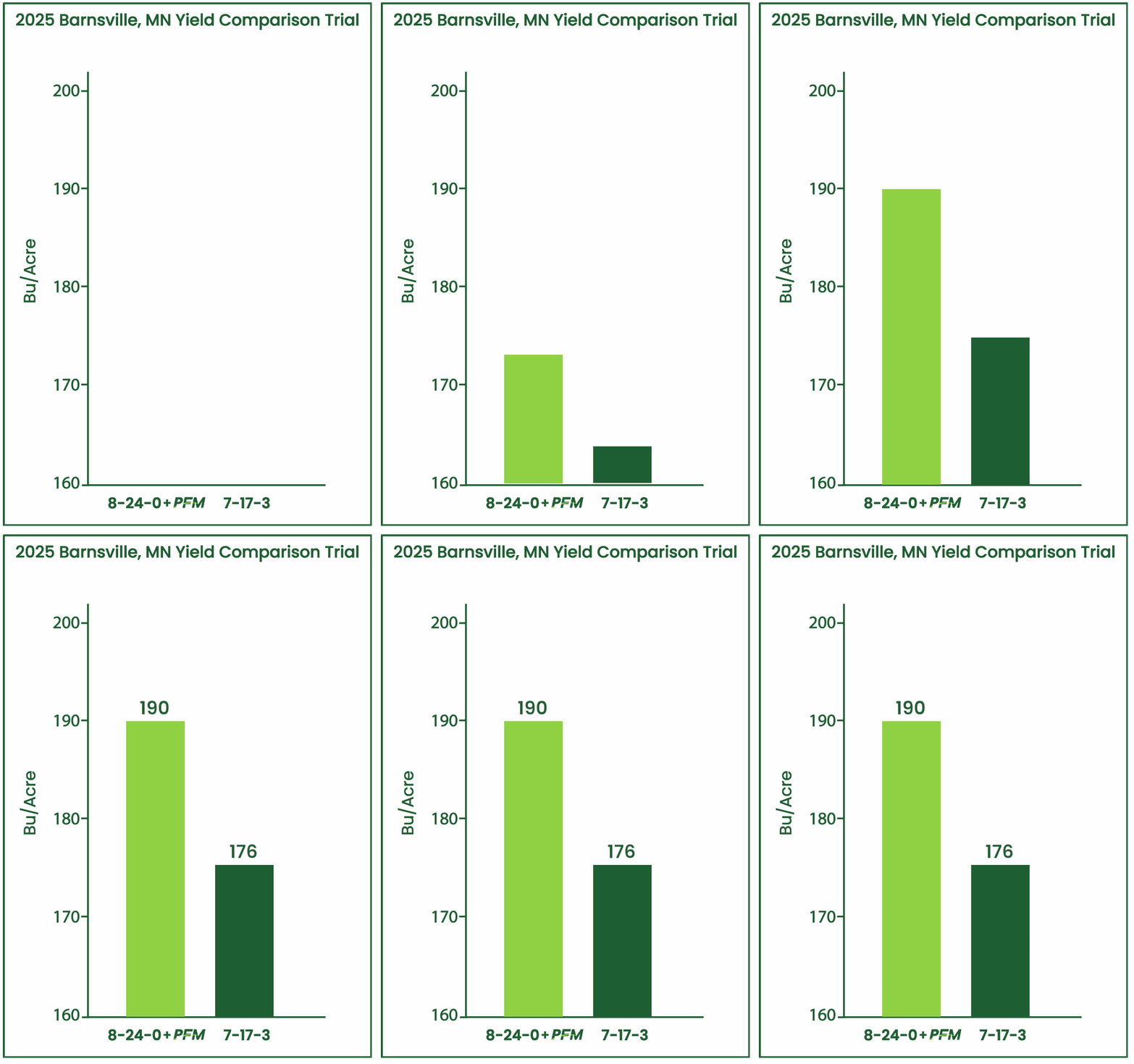
Fast forward to the results that were harvested in October of 2025, which showed an 8% yield increase in relation to the grower standard program. The 3 gallons of 8-24-0 + PFM™ field returned 190 bushels per acre, while the 5 gallons 7-17-3 finished at 176 bushels per acre.
Of course, if you’ve followed our newsletter or caught these blogs you’d know, this isn't the first time this has happened. Different crop, University trial, PFM™ vs. Grower Standard on 3 varieties of potatoes netted a 10.1% average yield advantage. In Iowa last year, 8 gallons of 10-34-0 vs. 3 gallons of 8-24-0+PFM™ on corn netted a 7.75% average increase in yield.
The conversation shouldn’t be about adding more phosphorus. It should be about getting more out of what was already applied.
When you see a lower rate out perform a higher one, it forces a different question:
Is the limiting factor really how much phosphorus is applied, or how well it’s being used?
In this case, the answer showed up at harvest.
Why This Trial Matters
It’s easy to look at a 14 bushel gain and just chalk it up as a “good result.”
But when you layer in the fact that it was done with less product, it starts to point to something bigger. Without the PFM™, starter fertilizer programs quietly lose efficiency, not because they’re poorly designed, but because phosphorus is naturally prone to tie-up. Once it reacts in the soil, a portion of what you paid for is no longer immediately available to the crop, especially during that early window when it matters most.
So over time, programs get built around that reality. Rates get adjusted. Gallons creep up. Not dramatically, just enough to make sure performance stays consistent.
What this trial among our other trials suggests is that when your phosphorus starter fertilizer is managed differently, not just applied differently, that pattern can shift.
Instead of compensating for tie-ups, you’re reducing it. Instead of increasing volume, you’re improving function. And that’s how you end up with a situation where:
Fewer gallons are needed
Early availability improves
Yield response follows
Phosphorus Starter Fertilizer Habits That Hurt Yield
Growers aren’t doing phosphorus wrong. They’re doing what’s always worked. Get it in-furrow, get the crop going, move on to the next decision.
More phosphorus equals better performance.
But phosphorus doesn’t behave like nitrogen. You don’t just apply it and expect it to stay available. It ties up fast, especially in cooler soils, high pH environments, or when it interacts with calcium, iron, or aluminum.
So what happens? Over time, programs naturally get built to ensure consistency across conditions, often leaning on rate to make sure performance holds. This increases rates, adds more gallons, and spends more money to try and force performance.
Phosphorus Starter Fertilizer: Volume vs. Availability
We believe your phosphorus starter fertilizer is one of the most important passes you’ll make all season. No, you’re not feeding the crop for the year, but you are setting the tone for everything that follows.
Early phosphorus availability drives:
Root development
Early vigor
Stand consistency
Uniform emergence
If phosphorus isn’t available when that seedling needs it, you don’t get that time back.
And this is where most phosphorus starter fertilizer programs fall short. They deliver phosphorus, but not necessarily usable or available phosphorus at the right time. That gap between what’s applied and what’s actually taken up is where yield is lost.
Efficiency is the Future
Look at this from a program standpoint, not just a single pass. Most phosphorus starter fertilizer decisions are made to be dependable across a wide range of conditions.
You want something that works whether it’s a perfect spring or one that drags out.
What this trial points to isn’t replacing that thinking, it’s tightening it up.If you can get the same or better performance while putting out fewer units of P₂O₅, that changes how efficient that pass really is. Not just from a cost standpoint, but from how much of what you’re applying is actually contributing to yield and this adds up in a way that’s noticeable. Not because the program is drastically different, but because it’s doing a better job with what’s already being applied.
Phosphorus Starter Fertilizer Efficiency Matters More Than Rate
Phosphorus starter fertilizer isn’t just about what’s applied at planting, it’s about how effectively that phosphorus is used during early growth. When two programs produce different results with less applied phosphorus, it highlights the role of phosphorus fertilizer management in improving efficiency, consistency, and ultimately yield. PFM™ Technology by CultivAce brings an advantage to phosphorus starter fertilizers to put yield advantage back in the grower’s hand.