
You're Not Short on Phosphorus. You're Short on Available Phosphorus.
Phosphorus fertilizer prices have climbed, inputs are tighter, and margins are thinner than most growers want as planting is already underway in 2026, with roughly 11% complete. The instinct is understandable: pull back on rates, protect the budget, and hope the soil bank covers the gap. The problem is that the soil bank is less reliable than the balance sheet suggests, not because phosphorus isn't there, but because most of it was never plant-available to begin with.
That’s the tension in liquid phosphorus fertilizer management in 2026. Growers are under real cost pressure. But the answer isn't less phosphorus, it's more efficient phosphorus. And right now, those two things are being confused for the same fix.
The Fixation Problem Nobody Talks About Enough
Soil fixation is the quiet tax on every phosphorus application. When phosphate ions hit the soil, regardless of whether they come from 10-34-0, 9-24-0, DAP, or MAP, they bind rapidly to calcium, iron, and aluminum ions depending on soil pH. In alkaline soils above 7.0, calcium phosphate compounds form and lock phosphorus out of the root zone. In acidic soils, iron and aluminum do the same job. The result in both cases is the same: phosphorus sits in the soil, registered on a soil test, and yet largely unavailable to the plant during the critical early-growth window when it matters most.

Research consistently puts first-year phosphorus use efficiency from conventional applications somewhere between 10 and 30 percent. The rest doesn't disappear, it accumulates in the soil, but it's not doing anything for this season's crop. Growers are effectively pre-paying for phosphorus their plants can't use, then wondering why cutting the rate doesn't hurt yield as much as expected. It often doesn't because the crop was only capturing a fraction of what was applied to begin with.
Industry blogs heading into 2026 are correctly identifying placement and timing as partial solutions. Banding versus broadcasting, in-furrow versus broadcast, split applications, these are real improvements. Approximately 93 percent of phosphorus reaches the plant through diffusion rather than root interception or mass flow, which is why proximity to the root matters so much. But placement and timing only go so far if the underlying chemistry of the phosphate source remains unchanged. This is the gap most of the industry conversation isn't addressing.
The Chemistry Gap, and Why Source Matters
Not all phosphate is the same at the molecular level. Conventional liquid starters like 10-34-0 contain a mix of orthophosphate and polyphosphate. Plants can only absorb phosphorus in the orthophosphate form. Polyphosphate has to convert in the soil first, a process that depends on soil temperature, moisture, and microbial activity. In cold, early-spring soils, that conversion is slow. The crop is asking for phosphorus at emergence, and the fertilizer hasn't finished becoming available yet.
This is where source chemistry becomes agronomically significant, not just academically interesting. A liquid phosphorus fertilizer formulated with 100 percent orthophosphate bypasses the conversion step entirely. The phosphate is immediately in the form the plant can use. Pair that with a formulation designed to keep phosphate from binding in the soil, staying soluble and mobile in the root zone rather than fixing to soil particles, and the efficiency dynamic changes substantially.
That's the premise behind CultivAce's PFM™ Technology. PFM™, Phosphorus Fertilizer Management, is CultivAce's proprietary approach built into their 8-24-0 formulation. It's not a coating or a soil amendment added after the fact. It's a formulation-level technology that keeps phosphate in its plant-available orthophosphate form, maintains solubility across a wider range of soil pH conditions, and is designed to stimulate soil biology in ways that support ongoing nutrient release. The result is a liquid phosphorus fertilizer that consistently performs at rates and volumes well below conventional starters.
The trial data behind PFM™ spans across multiple years, multiple crops, and multiple states, and it holds up.
What the Trials Actually Show
CultivAce has accumulated field trial data from Kansas to California, Indiana to Iowa, Wisconsin to Nebraska, and beyond. The pattern across those trials is consistent: PFM™-based formulations produce comparable or superior yields at substantially lower application volumes than conventional liquid phosphate programs. The economic story that follows is equally consistent.
62.5% Less applied volume vs. 10-34-0 in Iowa Corn Trials, same or better yield
+17 bu Yield advantage per acre over grower standard in 2024 Indiana 2x2 trial
$147 Per-acre gross revenue advantage over 6-24-6 + humic treatment in 2025 Minnesota Sugar Beet Trial
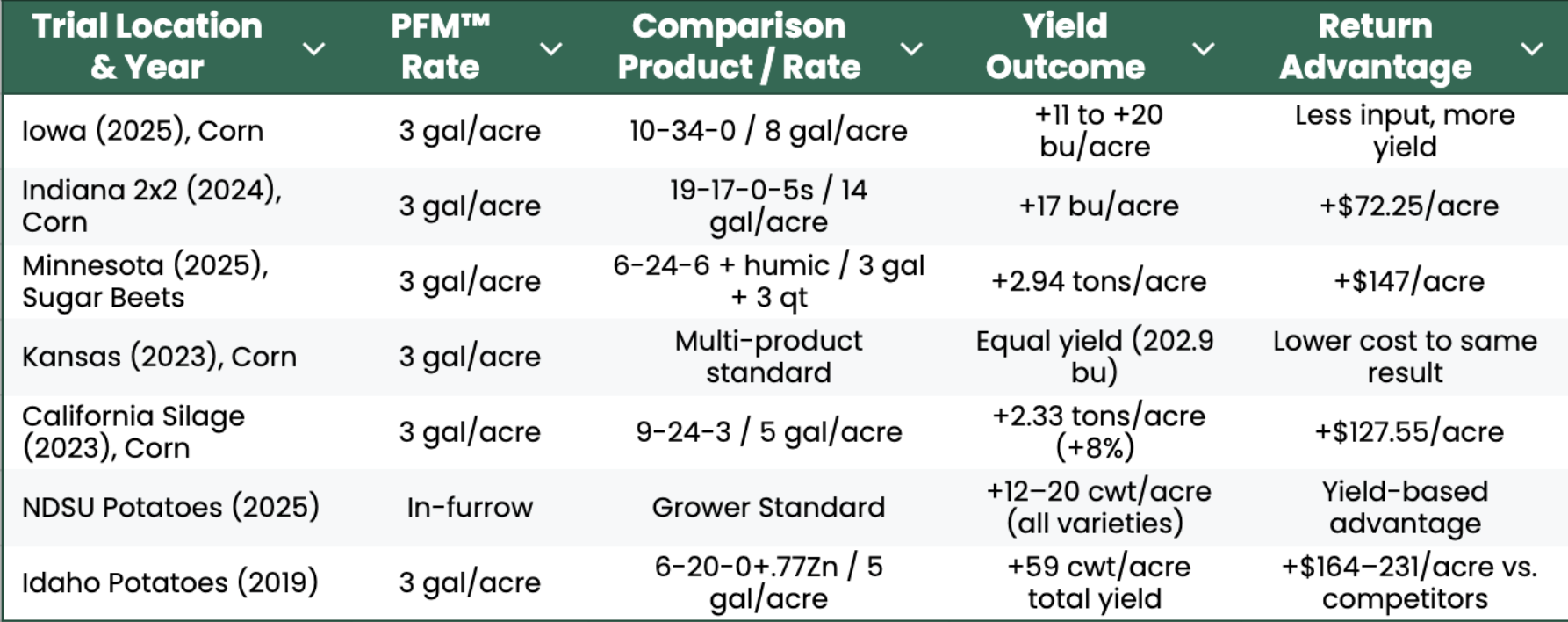
Take the 2025 Iowa corn trial near Northwood as a starting point. Two in-furrow treatments were compared across two field sites: conventional 10-34-0 at 8 gallons per acre, and 8-24-0 + PFM™ at 3 gallons per acre. At Field Site 1, 10-34-0 produced 203 bushels per acre. The 8-24-0 + PFM™ treatment produced 214. At Field Site 2, 10-34-0 yielded 198 bushels per acre, and 8-24-0 + PFM™ yielded 218. That's 5.4 percent and 10 percent yield advantages, respectively, achieved with 62.5 percent less applied fertilizer volume.
2025 Iowa Corn Trial, Northwood, Iowa

8-24-0 + PFM™ at 3 gal/acre vs. 10-34-0 at 8 gal/acre
Variety: Pioneer 9955V. Application: In-furrow, precision furrow jets. Prior crop: Soybean.
Variety: Pioneer 9955V. Application: In-furrow, precision furrow jets. Prior crop: Soybean.

8-24-0 + PFM™ at 3 gal/acre vs. 10-34-0 at 8 gal/acre
Field Site 2: 218 bu/acre (PFM™) vs. 198 bu/acre (10-34-0), +20 bu/acre advantage
+5.4% to +10% yield with 62.5% less volume
The 2023 eastern Kansas trial tells a different but equally important version of the same story. In Sedgwick, Kansas, a grower ran 10 acres of 8-24-0 + PFM™ at 3 gallons per acre against his standard program: 4.5 gallons of Pro-Germinator, 1.5 gallons of Kalibrate, 1 quart of Micro 500, and 1 pint of Mn EDTA, all in-furrow. At harvest, both treatments yielded 202.9 bushels per acre. Identical. But the PFM™ treatment got there with half the total product volume at a lower per-acre cost. This trial isn't about yield. It's about what you're spending to get there.
2023 Eastern Kansas Cost Reduction Trial
Free pHOS 24 (PFM™) vs. Complex Grower Standard Program

Eastern Kansas Trial Field Map
Both treatments yielded 202.9 bu/acre. Free pHOS 24 applied at 3 gal/acre achieved identical yield to a four-product grower standard program totaling far greater per-acre volume. Gross return was equal at $1,014.50/acre, but input costs favored PFM™ significantly.
Same yield. Half the volume. Lower cost.
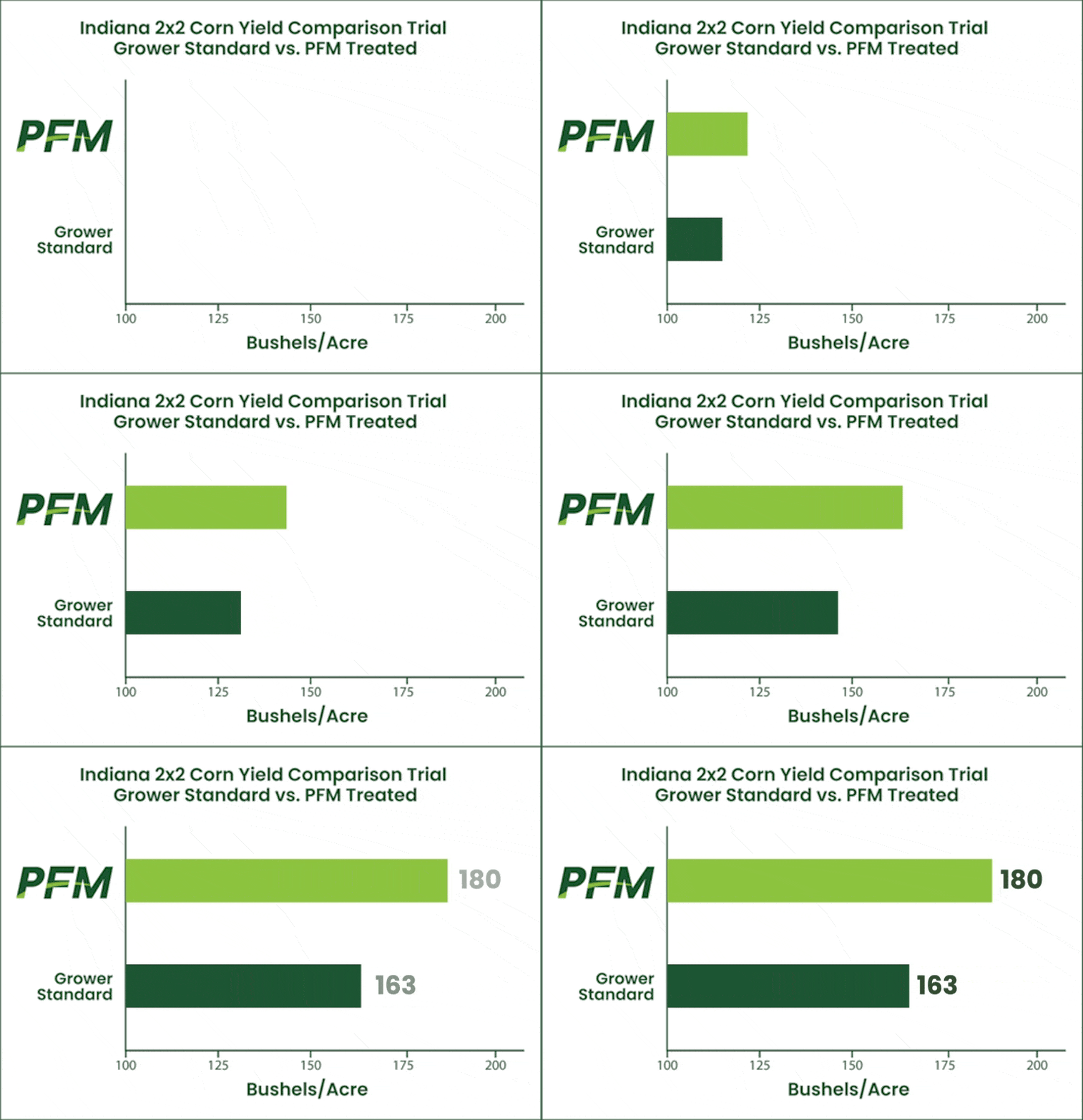
The 2024 Indiana 2x2 trial near South Bend extends the story further. The grower's standard treatment was 14 gallons per acre of 19-17-0-5s applied 2x2. The PFM™ treatment was 3 gallons per acre of 8-24-0 + PFM™ applied the same way, one-quarter the volume. Nitrogen levels were equalized through side-dress applications partway through the season. At harvest, the PFM™ plot yielded 180 bushels per acre against 163 for the standard treatment. That's a 17-bushel advantage, a $72.25-per-acre gross return improvement at $4.25 corn, achieved with a fraction of the starter application.
Across Crops, Not Just Corn
The PFM™ Technology data set isn't limited to corn, and that breadth matters when evaluating whether the phosphorus management principle holds or whether it's crop-specific.

PFM™ On the Right
In the 2025 third-party Minnesota sugar beet trial near Nordick, 8-24-0 + PFM™ applied at 3 gallons per acre in-furrow produced 31.24 tons per acre, the highest yield in a four-treatment comparison that included 10-34-0 at 3 gallons, 6-18-6-1S-0.46Zn at 5 gallons, and 6-24-6 plus humic and enzymes at 3 gallons plus 3 quarts. Recoverable sugar per acre followed the same ranking: 7,794 pounds for the PFM™ treatment versus 7,644 for 10-34-0 and 7,015 for the humic-blend treatment. At $50 per ton, 8-24-0 + PFM™ produced an estimated $147 more per acre in gross revenue than the humic product and $60.50 more than 10-34-0.
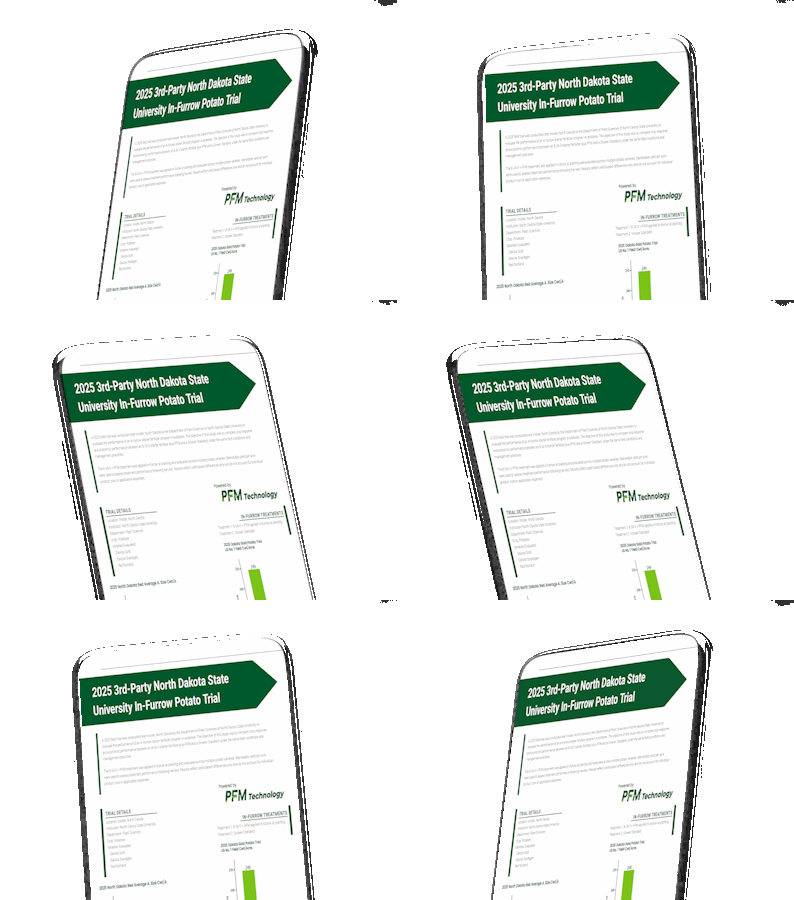
In the 2025 North Dakota State University in-furrow potato trial near Inkster, 8-24-0 + PFM™ outperformed the grower standard across all three potato varieties evaluated. Dakota Gold: 249 cwt/acre versus 222 for the standard. Dakota Skarlagen: 214 versus 201. Red Norland: 192 versus 172. This was an independent university trial, not a grower-sponsored evaluation, and the results were replicated across varieties.
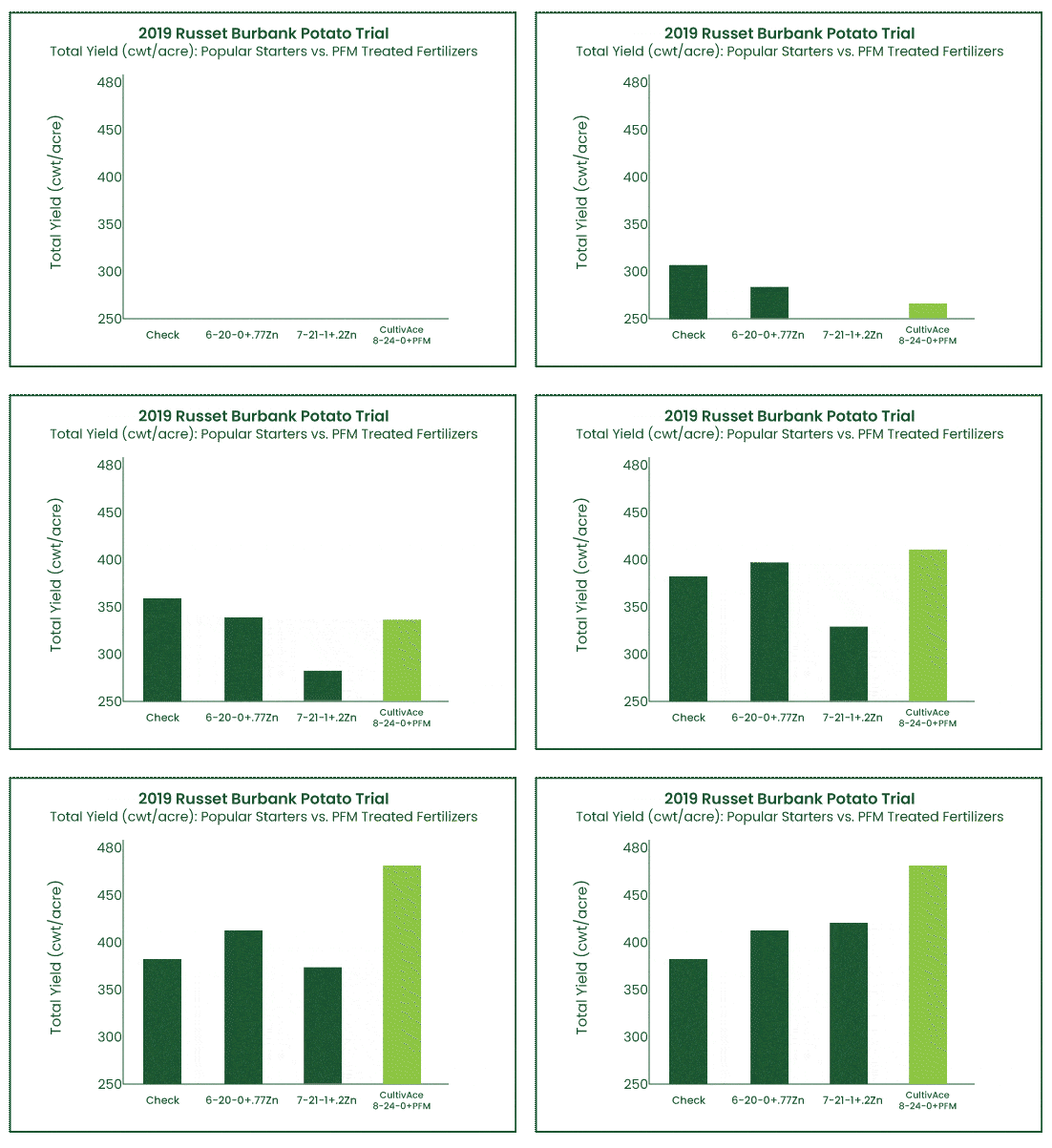
The 2019 Idaho Russet Burbank trial adds further depth to the potato picture. Applied at 3 gallons per acre in-furrow, 8-24-0 + PFM™ produced a total yield of 471 cwt/acre against 391 for the untreated check, 412 for a 6-20-0+.77Zn treatment at 5 gallons per acre, and 414 for a 7-21-1+.2Zn treatment at 5 gallons per acre. The PFM™ treatment outperformed competitors running more volume. Marketable yield and gross return followed the same pattern, $2,721 per acre for PFM™ versus $2,133 for the check and $2,490 for the closest competitor.
Growers who win in 2026 aren't applying more phosphorus. They're managing it better.
What the Silage and Tissue Data Adds
Yield data tells you what came off the field. Tissue data tells you what the plant actually took up, and that distinction matters for understanding why PFM™ performs the way it does.
The 2019 Clearwater, Washington potato tissue study compared Free pHOS 24 + PFM™ applied at 3 gallons per acre at planting plus 2 gallons through irrigation, against 10-34-0 applied at 6 gallons per acre at planting plus 4 gallons through irrigation. The PFM™ program ran at half the total applied volume. Tissue phosphorus levels were consistently higher in the PFM™ treatment throughout the early growth window, with 83 percent more phosphorus in tissue samples during early growth and a 50 percent increase in nitrate-nitrogen uptake. A fertilizer at half the rate, capturing more nutrients in tissue. That's the efficiency argument made visible.
On the yield side, the 2023 California silage trial in Newman posted a clean 8 percent advantage for Free pHOS 24 over a 9-24-3 fertilizer program. The PFM™ acres yielded 31.3 tons of silage per acre against 28.97 for the check, at a $55-per-ton silage price, that translated to $1,721.50 per acre versus $1,593.95, a $127.55-per-acre return difference over just 10 acres of treated ground. Over a full farm scale, those numbers compound quickly.
The Rate Conversation Needs to Change
The industry's current response to input cost pressure is mostly about application timing, placement, and rate adjustment. Those are all legitimate agronomic levers. Applying nutrients close to the seed zone or in targeted bands can significantly increase uptake, and planter-applied or banded fertilizers improve early crop development while reducing the total amount of inputs required. That's accurate as far as it goes.
But at the end of the day, it’s still a polyphosphate mix, and still subject to fixation in the root zone. The efficiency ceiling on conventional sources doesn't move much regardless of where or when you put them in the ground.
What PFM™ Technology represents is a different conversation: not how to apply conventional phosphorus more efficiently, but how to formulate it to be more efficient from the start. 100 percent orthophosphate means no conversion lag in cold soils. A formulation designed to stay soluble across pH ranges means less fixation before the root gets there. Lower salt index means in-furrow safety without sacrificing placement precision. These aren't marketing claims, they're the mechanism behind the trial results.
Where This Leaves You Heading Into 2026 Planting
The fundamental phosphorus management problem hasn't changed. Soil fixation is still happening. First-year use efficiency from conventional liquid phosphorus fertilizer sources is still well below what the rate on the label implies. The difference in 2026 is that input cost pressure is making the inefficiency harder to ignore.
Cutting phosphorus rates when efficiency is already low compounds the problem rather than solving it. What the data consistently points toward is a different approach: apply a smaller volume of a more available, more efficiently delivered liquid phosphorus fertilizer at or near the seed, and let the formulation do the work that additional gallons of conventional product can't.
"There is noticeably more root fiber with Free pHOS than the untreated check. In a year with low moisture, this will make a big difference."
-Matt S., Hampton, Iowa
That's not a theoretical position. Across corn, silage, sugar beets, potatoes, and soybeans, across Iowa, Indiana, Kansas, California, Minnesota, Nebraska, Ohio, Wisconsin, Kentucky, Michigan, South Dakota, North Dakota, Idaho, and Oregon, the trial data supporting PFM™ Technology points in the same direction. Less volume, competitive or superior yields, better return per acre. The University of Nebraska trial in York County showed a statistically significant yield advantage for Free pHOS 24 over 10-34-0 at a 90 percent confidence level, both applied at the same rate and volume. When the chemistry is better, the rate doesn't have to be higher.
The 2026 season hasn't told its story yet. But the growers entering it with a phosphorus management strategy, not just a phosphorus application rate, are positioned better than those treating input cost pressure as a reason to simply back off.
Phosphorus availability is the variable worth managing. PFM™ Technology is built around that premise, and the field data across multiple years and geographies continues to support it.